
Change Request Review Agent · Use case
How can we use an AI agent to check change requests before the change board meets on our own infrastructure?
A change request review agent reads one change request and sets it against your change policy: the plan, the test evidence, the rollback plan, the window and the approvals. It lists what is missing, with the rule behind each point. The change manager or the change board approves or rejects. The agent approves nothing, schedules nothing and changes no system. It runs on your own infrastructure, so change records are not sent to a public AI service.
The change board meets.
Requests arrive with parts missing.
- ✗ 01A change request reaches the change board without its test evidence, its rollback plan or one of its approvals, and the gap is found in the meeting.
- ✗ 02Change records describe how production systems are built and when they will be worked on, and are confidential.
Where it stops for a person
Always. The change manager or the change board approves or rejects.Always. The change manager or the change board decides every change. The agent checks that what the policy asks for is there, it does not judge whether the change is safe: a request with nothing missing has not been approved, and the agent gives no view on risk. An emergency change and a change your policy says needs the full board are marked for the change manager first.
It lists what is missing.
The board decides.
Step · 01
An engineer raises a change request, or the change manager uploads one.
Step · 02
The agent reads the request and its attachments.
Step · 03
It finds what your change policy requires for that kind of change: the plan, the test evidence, the rollback plan, the window and the approvals.
Step · 04
It lists what is present and what is missing, with the rule for each point, and marks anything it could not read.
Step · 05
The change manager returns the request to the engineer or puts it to the board, and the change manager or the board approves or rejects.
What a change manager sees
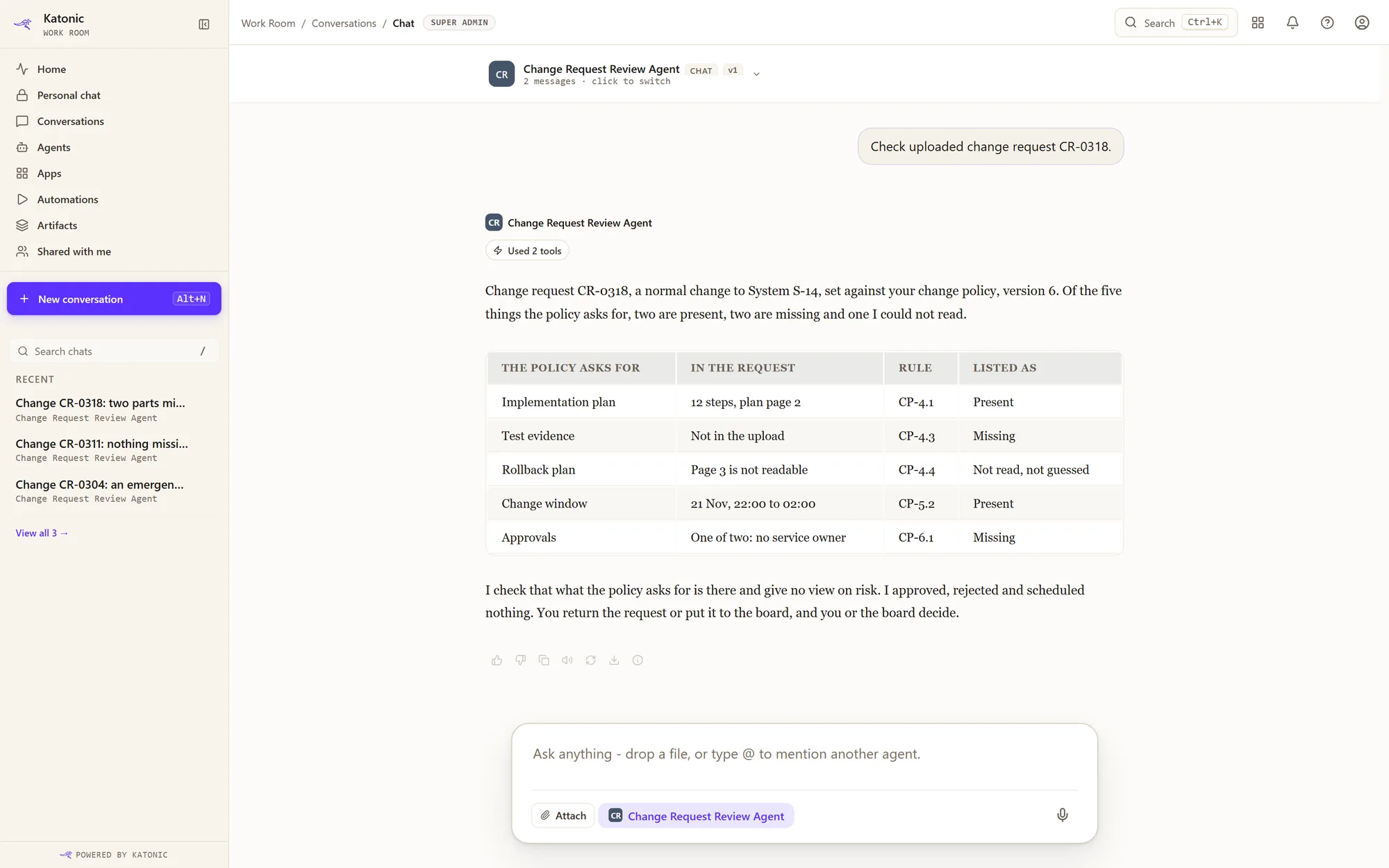
Tap the screen to open it at full size.
Reads from · connectors
 Your own APIs
The change request and its attachments, read as a ticket through a server from the catalogue or your own APIs with the operations that change something left out, or as uploaded files; and your change policy, indexed as a knowledge source.
What it can change
Nothing. It checks and lists. It approves, rejects and schedules no change, and changes no ticket and no system.
Your people ask it.
It replies in the same conversation.
Katonic calls this a conversational agent.
01 · Where your people use it
In Work Room
Your people find it in Work Room, under Agents. They ask in plain words, and it replies in the same conversation.
See Work Room →02 · Where they already work
In a screen they already use
Your developers can put it behind a screen your people already work in, so nobody has to open a new tool.
03 · With other agents
As a helper to another agent
A broader agent can call it for this one job and use its answer.
For your IT team. It can also be called through the REST API, and reached from other AI tools through the Katonic MCP Server. An action that is held for approval still waits for a person, however the agent is called.Public API →MCP Server →
What you set up
- Write down what each kind of change needs before it goes to the board.
- Index the change policy as a knowledge source, and connect the system that holds change requests, keeping only the operations that read.
- Build the agent in Katonic Studio and test it on past change requests, including ones the board sent back.
- Publish it to the change manager first, one kind of change at a time.
Where it runs
The agent, its knowledge store and the model run on infrastructure you own or control. You choose the model and serve it yourself, so questions, documents and answers are not sent to a public AI service. Change requests, plans and rollback plans stay inside the company.
How you get it today
You build it in Katonic Studio: describe the job, connect what is named above, add test cases and release the agent once it passes them. There is no ready-made template for this job yet.
Can the agent approve a low-risk change by itself?
No. It has no tool that approves or schedules a change. The change manager or the change board approves or rejects.
Does it judge how risky a change is?
No. It checks that the plan, the test evidence, the rollback plan, the window and the approvals your policy asks for are there. The judgement is the change manager's and the board's.
Where are change requests processed?
On your own infrastructure, with a model you serve. Nothing is sent to a public AI service.