
Service Desk Triage Agent · Use case
How can we use an AI agent to sort the tickets sent to our IT service desk on our own infrastructure?
A service desk triage agent reads each new ticket, says what kind of request or fault it is, lists what is missing before anyone can start, and proposes the priority and the team, with the routing rule behind each point. A service desk analyst confirms the kind, the priority and the team. The agent assigns no ticket, answers no colleague and changes no account or device. It runs on your own infrastructure, so tickets are not sent to a public AI service.
One queue for every ticket.
Each is read before anyone knows whose it is.
- ✗ 01Tickets reach the desk by email, chat, phone and a form, and an analyst reads each one to decide what it is, how urgent it is and who should have it.
- ✗ 02A ticket often arrives without the device, the system or the error message an engineer needs, and the first reply is a question.
Where it stops for a person
Always, before a ticket is assigned or a colleague is answered.Always. A service desk analyst confirms every kind, every priority and every team. It sorts a ticket, it does not work it: a ticket that asks for a password or a sign-in factor to be reset, or for access, is named as that kind and goes to an analyst, and the agent takes no step on it. A ticket it cannot place, a ticket that reports an outage or a possible security incident, and anything marked urgent are listed for an analyst first.
It proposes the kind, the priority and the team.
An analyst confirms.
Step · 01
A colleague raises a ticket, or an analyst opens one after a call.
Step · 02
The agent reads the ticket and its attachments.
Step · 03
It says what kind of request or fault it is, by the kinds your routing rules define, and gives the rule it used.
Step · 04
It lists what is missing for that kind of ticket and proposes the priority and the team from your rules.
Step · 05
A service desk analyst confirms the kind, the priority and the team, assigns the ticket in your own system and replies to the colleague.
What a service desk analyst sees
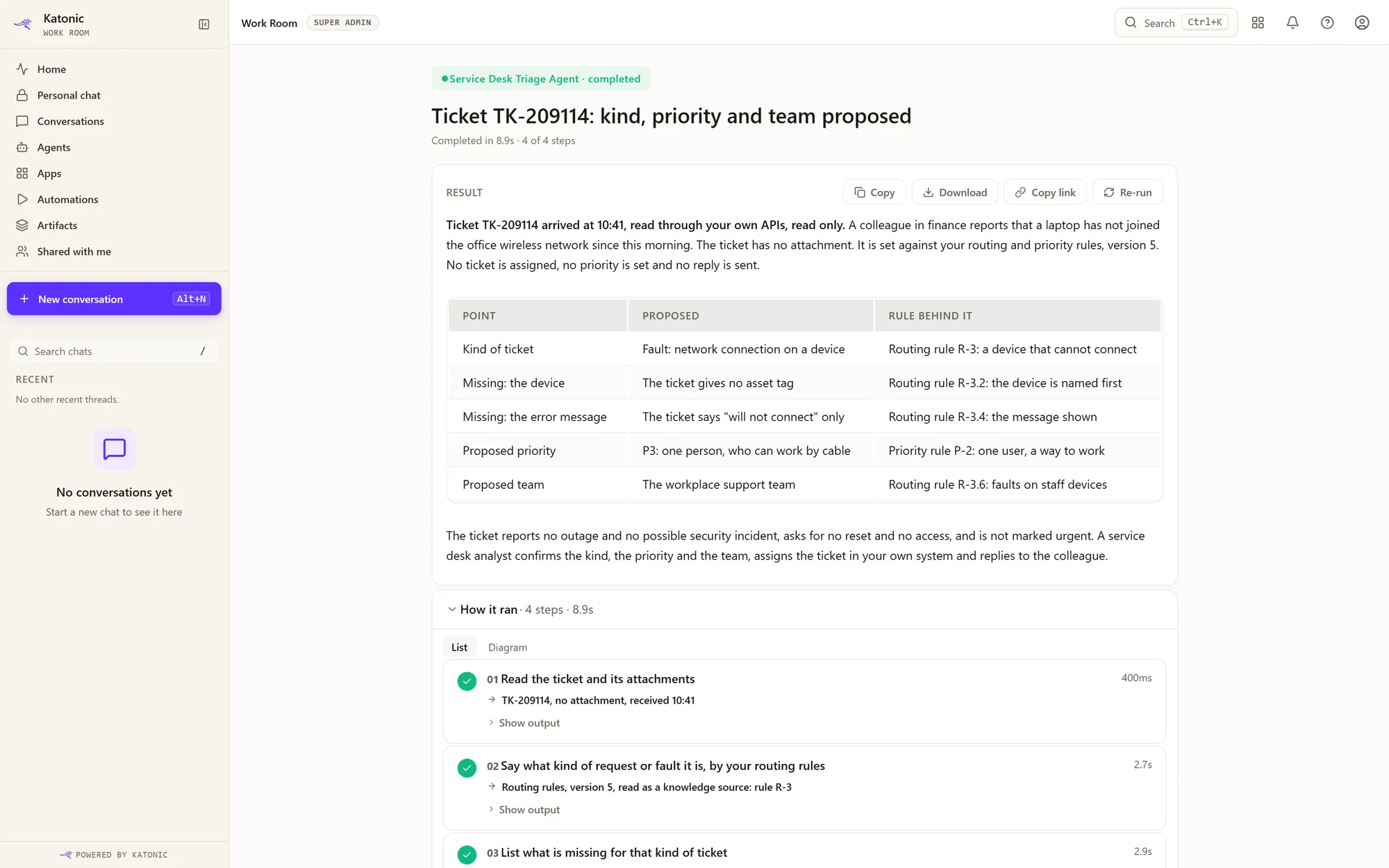
Tap the screen to open it at full size.
Reads from · connectors
 Your own APIs
The ticket and its attachments, read through a server from the catalogue deployed in your own cluster, or through your own APIs with the operations that change something left out; and your routing and priority rules, indexed as a knowledge source.
What it can change
Nothing. It classifies, lists and proposes. It assigns no ticket, sets no priority, changes no ticket and sends no reply.
Nobody has to ask.
It starts when something arrives.
Katonic calls this an event-triggered agent, one kind of workflow agent: it starts when something happens in a system, such as an email arriving, a file landing or a record changing.
What is an event-triggered agent? →The four types of agent →
01 · How it starts
When something arrives
Another system tells it that something has happened, and it starts by itself. Nobody has to watch a queue.
02 · Where your people see it
In Work Room, under Automations
Each run appears in Work Room under Automations. A run that needs a decision waits there for a person.
See Work Room →03 · Where they already work
In a screen they already use
Your developers can put it behind a screen your people already work in, so nobody has to open a new tool.
For your IT team. Another system can start a run through the REST API or a webhook. An action that is held for approval still waits for a person, however the run was started.Public API →
What you set up
- Write down the kinds of ticket, what each needs before work starts, the priority rules and which team takes which.
- Index those routing rules as a knowledge source, and connect the ticket system through a server from the catalogue or the description of its API, keeping only the operations that read.
- Build the agent in Katonic Studio and test it on a past month's tickets.
- Publish it to one service desk team first, one kind of ticket at a time.
Where it runs
The agent, its knowledge store and the model run on infrastructure you own or control. You choose the model and serve it yourself, so questions, documents and answers are not sent to a public AI service. Tickets, with the names, devices and systems they describe, stay inside the company.
How you get it today
You build it in Katonic Studio: describe the job, connect what is named above, add test cases and release the agent once it passes them. There is no ready-made template for this job yet.
Does the agent answer the colleague who raised the ticket?
No. It has no tool that sends anything. A service desk analyst replies.
Does it assign the ticket or set its priority?
No. It proposes both, with the rule it used. An analyst confirms and assigns the ticket.
Where are tickets processed?
On your own infrastructure, with a model you serve. Nothing is sent to a public AI service.