
Card Servicing Agent · Use case
How can a bank use an AI agent to help staff block, replace and dispute cards on its own infrastructure?
A card servicing agent works beside a member of staff who is on a call about a card. It finds the customer and the card, shows the card's status, recent payments and open disputes, and prepares a block, a replacement or a dispute. Each change waits for the member of staff to confirm, and for the approval rule the bank sets on that tool.
A lost card. A customer on the line.
Several screens to open.
- ✗ 01On a call about a lost card, a member of staff finds the customer, the card, the payments since the loss and any open dispute, each on a different screen.
- ✗ 02A block or a dispute raised on the wrong card or the wrong payment has to be undone while the customer waits.
Where it stops for a person
Before every change. The disputes team decides any refund.The member of staff confirms every block, replacement and dispute before it is requested. Whether the customer gets money back, and who is liable, is decided by the disputes team.
It prepares the request.
The member of staff confirms.
Step · 01
A member of staff tells the agent who is calling and why, by customer id, name or the last four digits of the card.
Step · 02
The agent finds the customer and the card, and asks when more than one customer matches.
Step · 03
It reads the card, its recent payments, its disputes and the customer's recent contacts.
Step · 04
It says exactly what it proposes, with each payment and the total, and asks the member of staff to confirm.
Step · 05
After a change it reports each action on its own line with what the card system returned: applied, refused, or waiting for approval.
What a member of the card servicing team sees
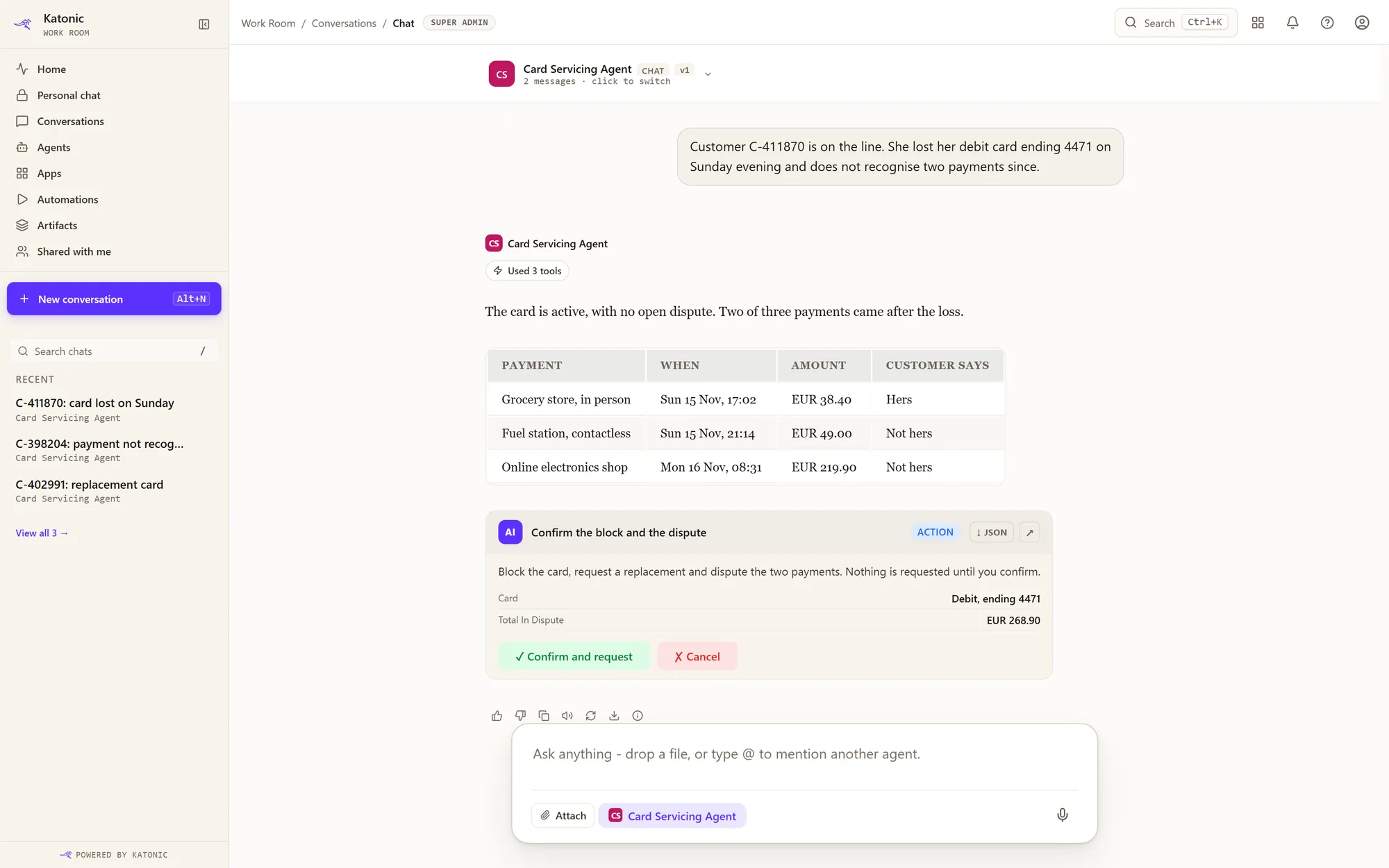
Tap the screen to open it at full size.
Reads from · connectors
 Your own APIs
Your customer records and your card system, each through its own API.
Acts through · your own APIs
Three operations of the card system: block a card, request a replacement and open a dispute. Each is a separate tool with an approval rule.
Your people hand it a job.
It acts once a person approves.
Katonic calls this an acting agent, one kind of conversational agent: it carries out a request through the tools it has been given, and anything that changes a record waits for a person.
01 · Where your people use it
In Work Room
Your people find it in Work Room, under Agents, and hand it the job in plain words. Anything that would change a record waits there for their approval.
See Work Room →02 · Where they already work
In a screen they already use
Your developers can put it behind a screen your people already work in, so nobody has to open a new tool.
03 · With other agents
As a helper to another agent
A broader agent can call it for this one job and use its answer.
For your IT team. It can also be called through the REST API, and reached from other AI tools through the Katonic MCP Server. An action that is held for approval still waits for a person, however the agent is called.Public API →MCP Server →
What you set up
- Import the API descriptions of the customer records and the card system.
- Set an approval rule on each of the three tools that change something.
- Check on your own platform that a change is held before staff use it.
Where it runs
The agent, its knowledge store and the model run on infrastructure you own or control. You choose the model and serve it yourself, so questions, documents and answers are not sent to a public AI service. Card and customer data stay inside the bank.
How you get it today
You build it in Katonic Studio: describe the job, connect what is named above, add test cases and release the agent once it passes them. There is no ready-made template for this job yet.
Does the agent talk to the customer?
No. It helps the member of staff, who speaks to the customer.
Can it unblock a card or change a limit?
No. It has three tools that change something: block, replacement and dispute. It has no tool to unblock a card or to change a limit or a customer detail.
Who decides a refund?
The disputes team. The agent opens the dispute with the payments the customer questions and decides nothing about the outcome.