
Management Reporting Agent · Use case
How can a bank use an AI agent to answer questions on its finance warehouse on its own infrastructure?
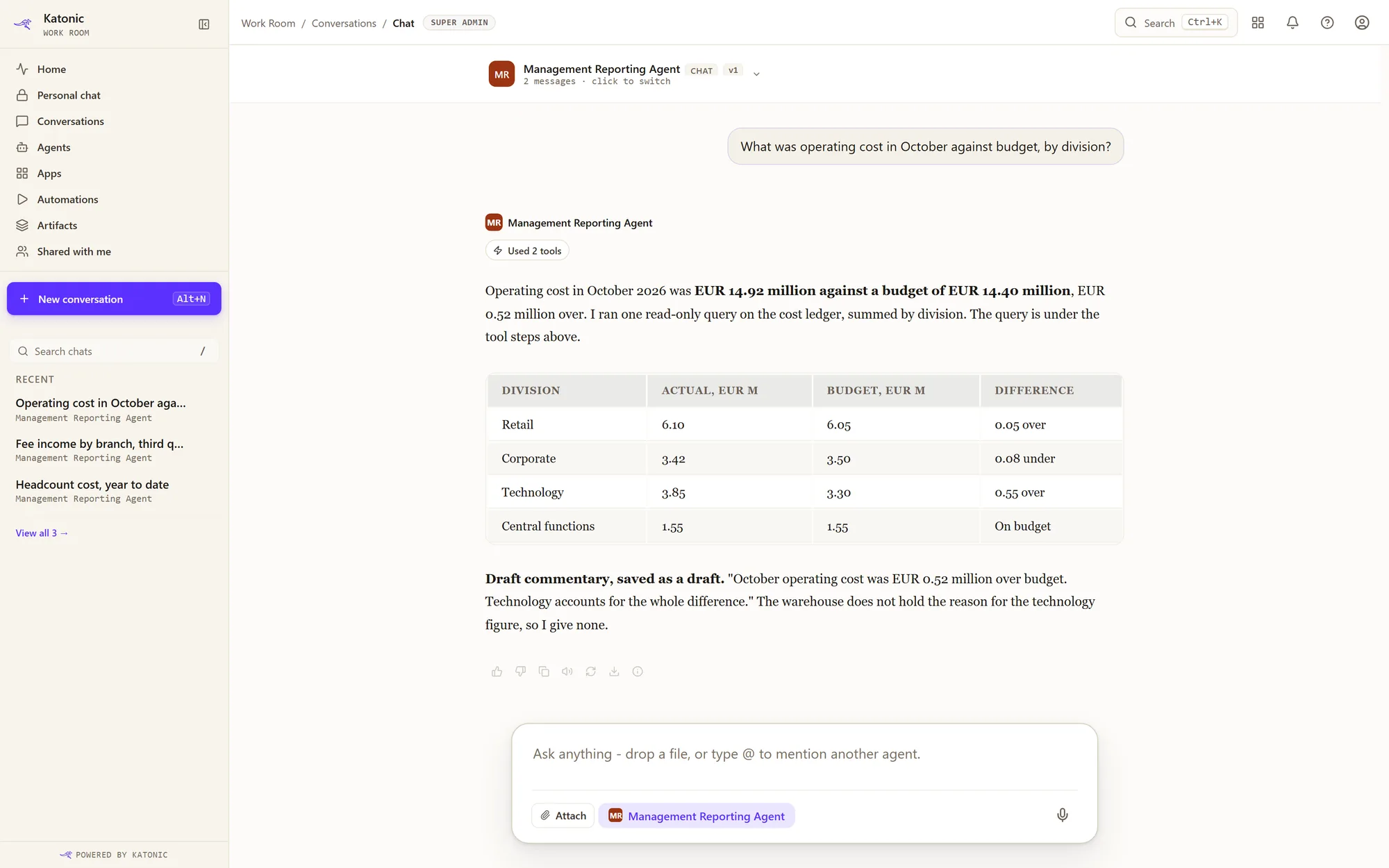
A management reporting agent answers a question on the bank's finance warehouse in plain language. It reads the table and column descriptions, runs one read-only query, shows the query and the rows that answer the question, and drafts a short commentary from those figures alone. It only reads, and when the warehouse does not hold the answer it says so and gives no estimate.
A question for finance.
A wait for the number.
- ✗ 01A manager's question about cost against budget goes to an analyst, who writes a query, checks it and writes the commentary.
- ✗ 02An answer without the query behind it cannot be checked, and ledger data cannot be sent to a public AI service.
Where it stops for a person
A person in finance decides whether to use the answer.A person in finance reads the answer and the commentary and decides whether to use them. Figures are changed through the bank's own process, not by the agent.
It runs the query and shows it.
Finance decides what to use.
Step · 01
A person in finance asks a question, such as operating cost last month against budget.
Step · 02
The agent reads the warehouse's tables and column descriptions, and fixes what the period and each term mean.
Step · 03
It runs one read-only query and lets the query do the sums.
Step · 04
It answers with the figures exactly as returned, and shows the query and a table of the rows.
Step · 05
It drafts a short commentary that uses only those figures, and saves it as a draft.
What a person in finance sees
Tap the screen to open it at full size.
Reads from · connectors
 Your own APIs
Your finance warehouse: the general ledger and management accounts, through an API or a database connection that can only read.
Acts through · your own APIs
One operation that saves the draft commentary.
Your people ask it.
It answers from your documents.
Katonic calls this an answering agent, one kind of conversational agent: it answers questions from knowledge you have approved and shows the source, and it changes nothing in any system.
01 · Where your people use it
In Work Room
Your people find it in Work Room, under Agents. They ask in plain words, and it replies in the same conversation.
See Work Room →02 · Where they already work
In a screen they already use
Your developers can put it behind a screen your people already work in, so nobody has to open a new tool.
03 · With other agents
As a helper to another agent
A broader agent can call it for this one job and use its answer.
For your IT team. It can also be called through the REST API, and reached from other AI tools through the Katonic MCP Server. An action that is held for approval still waits for a person, however the agent is called.Public API →MCP Server →
What you set up
- Connect the finance warehouse with a user that can only read.
- Describe each table and column, and what terms such as operating cost include.
- Test it on questions whose answer you already know.
Where it runs
The agent, its knowledge store and the model run on infrastructure you own or control. You choose the model and serve it yourself, so questions, documents and answers are not sent to a public AI service. Ledger data stays inside the bank.
How you get it today
You build it in Katonic Studio: describe the job, connect what is named above, add test cases and release the agent once it passes them. There is no ready-made template for this job yet.
How do we know the number is right?
The agent shows the query it ran and the rows it returned, so an analyst can check both.
Does it explain why a figure moved?
Only as far as the data shows. The warehouse holds amounts and accounts, not reasons, and the agent invents none.
What if the warehouse does not hold the answer?
It says so, names what is missing and gives no estimate.