
Adverse Media Screening Agent · Use case
How can a bank use an AI agent to screen a customer for adverse media on its own infrastructure?
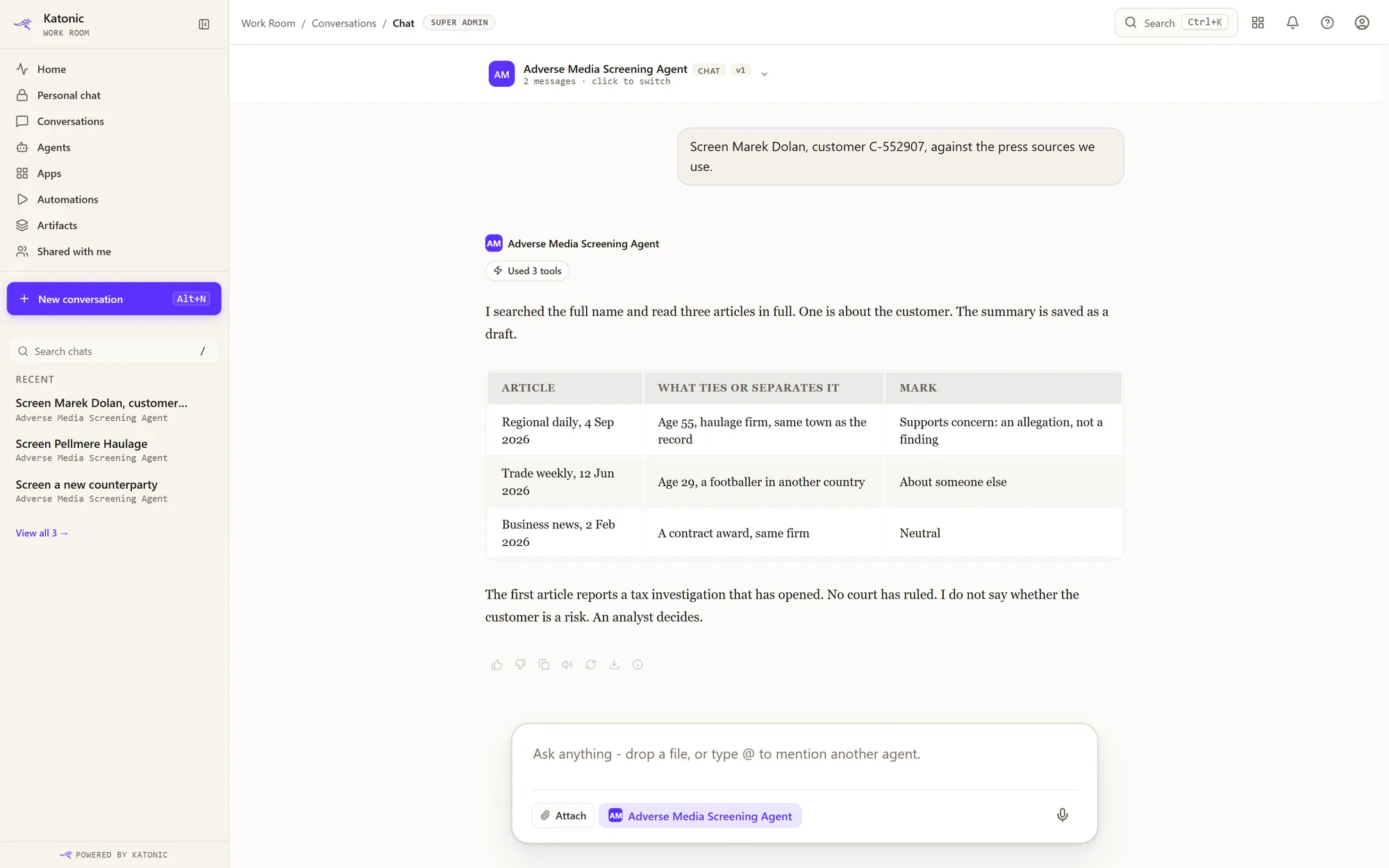
An adverse media screening agent is given the name of a customer or counterparty. It searches the press sources the bank names, reads each article in full and sets the facts in it beside the bank's own record. For each article it says whether it is adverse and about the subject, about someone else with the same name, or neutral, with the link. A compliance analyst decides what it means.
A common name. Dozens of articles.
Which ones are about the customer?
- ✗ 01A search on a name returns articles about several people. An analyst reads each one to work out whether it is about the customer at all.
- ✗ 02Coverage of a namesake or a relative recorded against the wrong person is a serious error, and it is easy to make at volume.
Where it stops for a person
Always. An analyst decides whether the subject is a risk.A compliance analyst reads the summary and decides. The agent does not say that a subject is a risk or is cleared, close an alert or open a case.
It reads every article.
An analyst decides.
Step · 01
An analyst, or another agent, gives it the subject to screen.
Step · 02
It plans its own search: the full name first, then the parts of it when that finds nothing.
Step · 03
It reads every article in full and compares the age, town, country and trade reported with the same facts in the bank's record.
Step · 04
It marks each article as supporting concern, neutral, about someone else, or unclear, with the facts that tie or separate the two.
Step · 05
It saves the summary as a draft with each article's link, and says where an article reports an allegation and not a finding.
What a compliance analyst sees
Tap the screen to open it at full size.
Reads from · connectors
 Your own APIs
The press archive or search service the bank names, and the customer record, each through its own API.
Acts through · your own APIs
One operation that saves the draft summary.
You give it a goal.
It plans its own steps.
Katonic calls this an autonomous agent.
01 · Where your people use it
In Work Room
Hand it the question in Work Room. It proposes a plan and waits for your approval, then works for some minutes and comes back with a report.
See Work Room →02 · Where they already work
In a screen they already use
Your developers can put it behind a screen your people already work in, so nobody has to open a new tool.
What you set up
- Import the API descriptions of the press source and the customer record.
- Name the sources the agent may search.
- Test it on subjects with a known namesake before anyone relies on it.
Where it runs
The agent, its knowledge store and the model run on infrastructure you own or control. You choose the model and serve it yourself, so questions, documents and answers are not sent to a public AI service. The names you screen are not sent to a public AI service.
How you get it today
You build it in Katonic Studio: describe the job, connect what is named above, add test cases and release the agent once it passes them. There is no ready-made template for this job yet.
How does it handle two people with the same name?
It treats an article as about the subject only when a detail ties them together, such as age, town or trade. Otherwise it marks the article as about someone else and never merges two people.
Does coverage of a relative count against the customer?
No. It reports that the article is about the relative and not about the subject.
Which sources does it search?
The ones the bank names. It reaches them through their own API.