
Equity Research Report Agent · Use case
How can a bank use an AI agent to draft an equity research report on its own infrastructure?
An equity research report agent is given a company, a period and what the report is for. It plans what to read, reads the filings, the share prices and the consensus estimates, and drafts the report as a table the analyst checks row by row, with the filing and line of every figure. It gives no rating, no price target and no recommendation: the analyst does.
Results day. Several companies report.
Every figure has to be found and checked.
- ✗ 01On results day an analyst pulls figures from filings into a model before the thinking can start.
- ✗ 02A half-year figure set against a full-year one, or a figure a later filing restated, is an error a reader will find.
Where it stops for a person
Always. The analyst checks the draft and writes the view.The analyst reads the draft, checks it and writes the report. The agent forecasts nothing, and it does not call a share cheap or dear.
It drafts with the source of every figure.
The analyst writes the view.
Step · 01
An analyst names a company, the period and what the report is for.
Step · 02
The agent plans its reading: the company, each filing in full, the share prices around the results and the consensus.
Step · 03
It drafts the report as a table: the business, the figures, the growth and margins it worked out, the valuation measures with the working shown, and the risks the filings state.
Step · 04
It uses the restated figure where a later filing restates an earlier one, shows both, and says when the consensus is older than the latest filing.
Step · 05
It marks every row sourced, worked out, differs or missing, and saves the draft.
What a research analyst sees
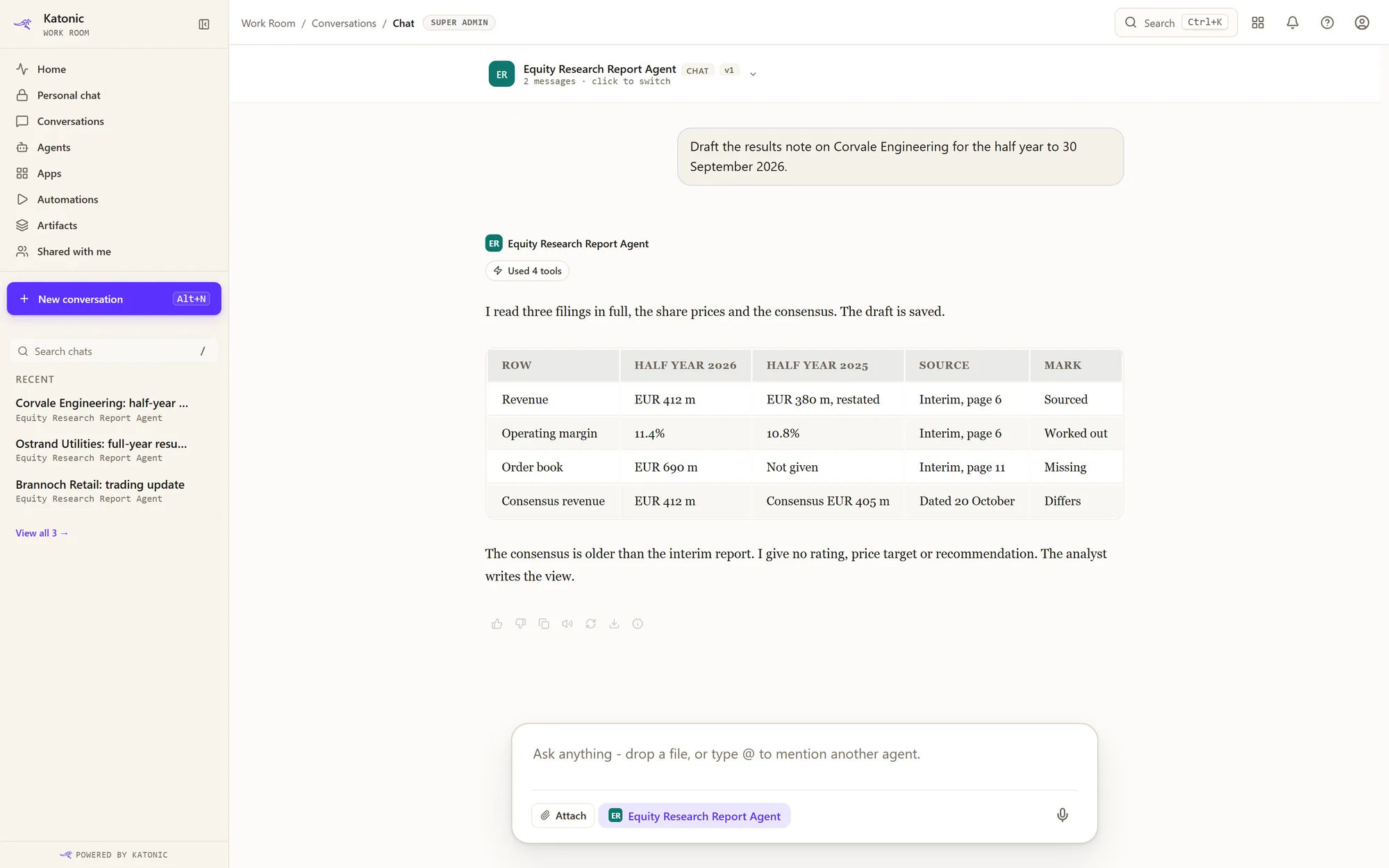
Tap the screen to open it at full size.
Reads from · connectors
 Your own APIs
Your research data: the listed companies, their filings, share prices and consensus estimates, each through its own API.
Acts through · your own APIs
One operation that saves the draft report.
You give it a goal.
It plans its own steps.
Katonic calls this an autonomous agent.
01 · Where your people use it
In Work Room
Hand it the question in Work Room. It proposes a plan and waits for your approval, then works for some minutes and comes back with a report.
See Work Room →02 · Where they already work
In a screen they already use
Your developers can put it behind a screen your people already work in, so nobody has to open a new tool.
What you set up
- Import the API descriptions of your research data sources.
- Agree the sections of the report.
- Test it on a company whose figures your analysts have already checked.
Where it runs
The agent, its knowledge store and the model run on infrastructure you own or control. You choose the model and serve it yourself, so questions, documents and answers are not sent to a public AI service. Draft research is not sent to a public AI service before it is published.
How you get it today
You build it in Katonic Studio: describe the job, connect what is named above, add test cases and release the agent once it passes them. There is no ready-made template for this job yet.
Does it give a buy or sell rating?
No. It gives no rating, no price target and no recommendation. The analyst does.
What if a figure is not in the filings?
The row is marked missing. The agent does not estimate it or take it from memory.
Should the arithmetic be checked?
Yes. The report is a draft, and it shows the working for each measure so that an analyst can check it.