
Incident Response Agent · Use case
How can a bank use an AI agent to draft the first assessment of an IT incident on its own infrastructure?
An incident response agent takes an incident as it is opened. A manager agent sends three specialists: one gathers the incident's timeline and metrics, one searches the recent changes and the runbook, and one saves the finished text. The result is a first assessment in a fixed order, from what is failing to what to check next, with the record behind every statement. It changes no service: the engineer on call decides what to do.
An incident opens at night.
The first half hour goes on finding the facts.
- ✗ 01When an incident opens, the engineer on call reads the dashboards, the recent changes and the runbook before deciding anything.
- ✗ 02A change made last week is easy to miss, and operational data about a bank's systems cannot be sent to a public AI service.
Where it stops for a person
Always. The engineer on call decides what to do.The engineer on call reads the assessment and decides what to do. The agent restarts nothing, rolls back nothing and does not change the incident's severity.
It drafts the first assessment.
The engineer on call decides.
Step · 01
An incident is opened. Your IT operations system announces it, or a person names it.
Step · 02
One specialist reads the incident, its timeline and the measures of each service affected, and reports every gap in the data as a gap.
Step · 03
A second runs a fixed set of searches over recent changes and returns the runbook of the affected service, every step.
Step · 04
The manager writes the assessment: what is failing, since when, what changed just before, the likely cause, the evidence for and against, what is not known and what to check next.
Step · 05
A third specialist saves it once as a draft note on the incident.
What the engineer on call sees
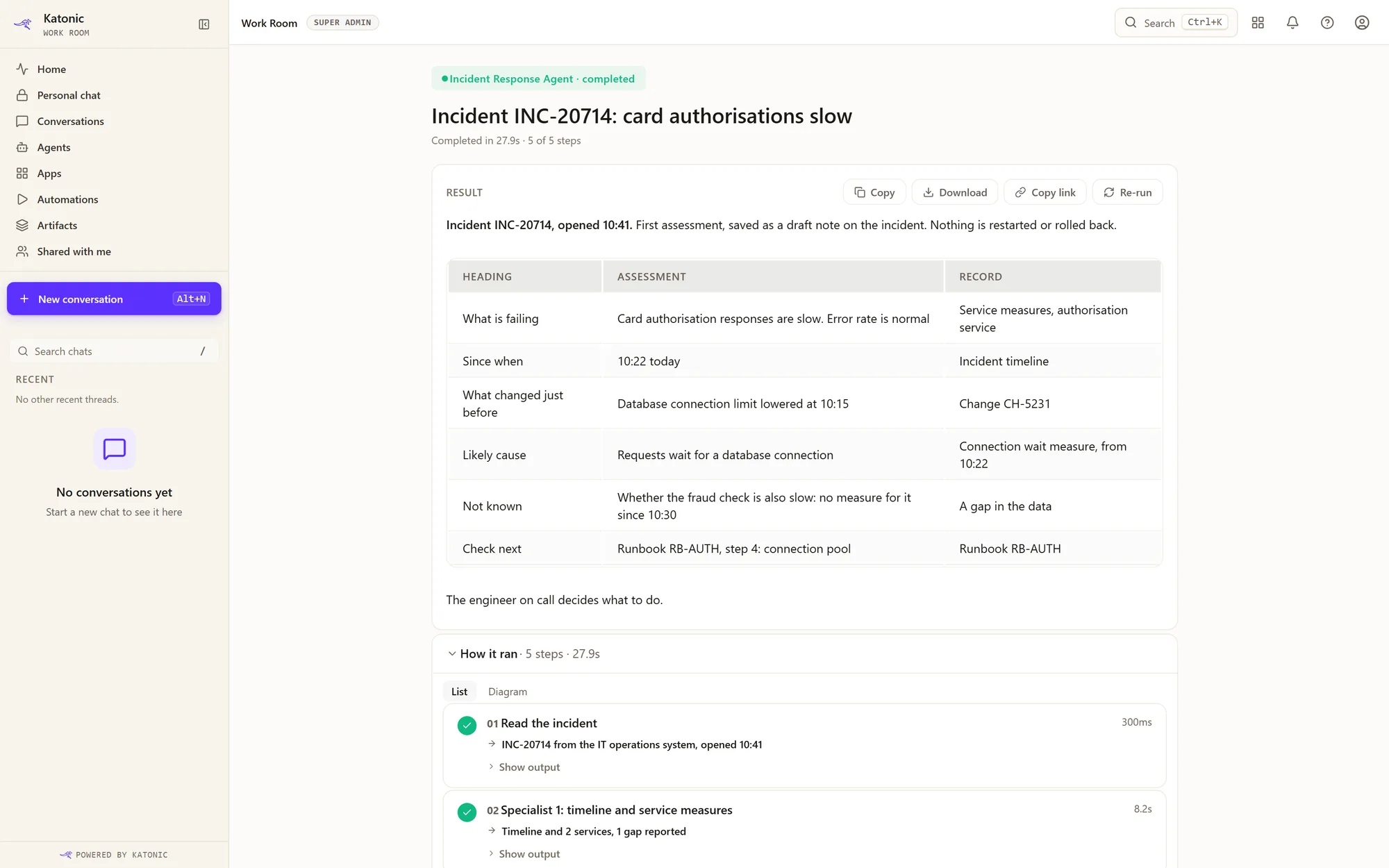
Tap the screen to open it at full size.
Reads from · connectors
 Your own APIs
Your IT operations system: incidents, metrics, dashboards, changes and runbooks, through its own API.
Acts through · your own APIs
One operation that saves a draft note. Only one of the three specialists holds it.
Nobody has to ask.
It starts when something arrives.
Katonic calls this an event-triggered agent, one kind of workflow agent: it starts when something happens in a system, such as an email arriving, a file landing or a record changing.
What is an event-triggered agent? →The four types of agent →
01 · How it starts
When something arrives
Another system tells it that something has happened, and it starts by itself. Nobody has to watch a queue.
02 · Where your people see it
In Work Room, under Automations
Each run appears in Work Room under Automations. A run that needs a decision waits there for a person.
See Work Room →03 · Where they already work
In a screen they already use
Your developers can put it behind a screen your people already work in, so nobody has to open a new tool.
For your IT team. Another system can start a run through the REST API or a webhook. An action that is held for approval still waits for a person, however the run was started.Public API →
What you set up
- Import the IT operations system's API description.
- Build the manager and its three specialists, each with only the tools its job needs.
- Run it on closed incidents whose cause you already know.
Where it runs
The agent, its knowledge store and the model run on infrastructure you own or control. You choose the model and serve it yourself, so questions, documents and answers are not sent to a public AI service. Operational data about the bank's systems stays inside the bank.
How you get it today
You build it in Katonic Studio: describe the job, connect what is named above, add test cases and release the agent once it passes them. There is no ready-made template for this job yet.
Why is it built as a manager with three specialists?
Each specialist has one job and only the tools for it. The change search always runs in full, and only one specialist can save.
Can it roll back a change or restart a service?
No. It has no tool that changes a service. It reports the runbook's steps, including the ones that need an approval.
Does it name the cause?
It names the likely cause with the evidence for and against it, and says what is not known.