
Third-Party Risk Assessment Agent · Use case
How can a bank use an AI agent to assess a supplier against its own standard on its own infrastructure?
A third-party risk assessment agent takes a supplier's completed questionnaire and the evidence it gave. It compares them with the bank's standard for suppliers, requirement by requirement, marks each one met, partly met, not met or not answered with its reason, and drafts the assessment with a recommendation. It approves nothing: the risk officer decides, and the committee the standard names approves the most critical suppliers.
A long questionnaire.
Is the evidence behind each answer?
- ✗ 01A supplier answers yes to a requirement and attaches a certificate that expired, or that covers a different service. Someone has to read both.
- ✗ 02An assessment is only as good as the weakest answer nobody checked.
Where it stops for a person
Always. The risk officer decides, and an unmet requirement needs a recorded exception.The risk officer decides. The agent does not approve a supplier, accept an unmet requirement or grant an exception.
It marks requirement by requirement.
A risk officer decides.
Step · 01
A supplier's completed questionnaire arrives and the risk officer opens the case.
Step · 02
The agent finds the supplier's tier and, from the standard, which requirements apply.
Step · 03
For each requirement it gives the mark, the supplier's answer in a few words, the evidence it relied on and the reason.
Step · 04
An answer with no evidence, or with evidence that says something else, does not meet the requirement. A blank answer is left blank.
Step · 05
It ends with one recommendation chosen by rule: approve, approve with conditions, ask the supplier, or do not approve.
What a risk officer sees
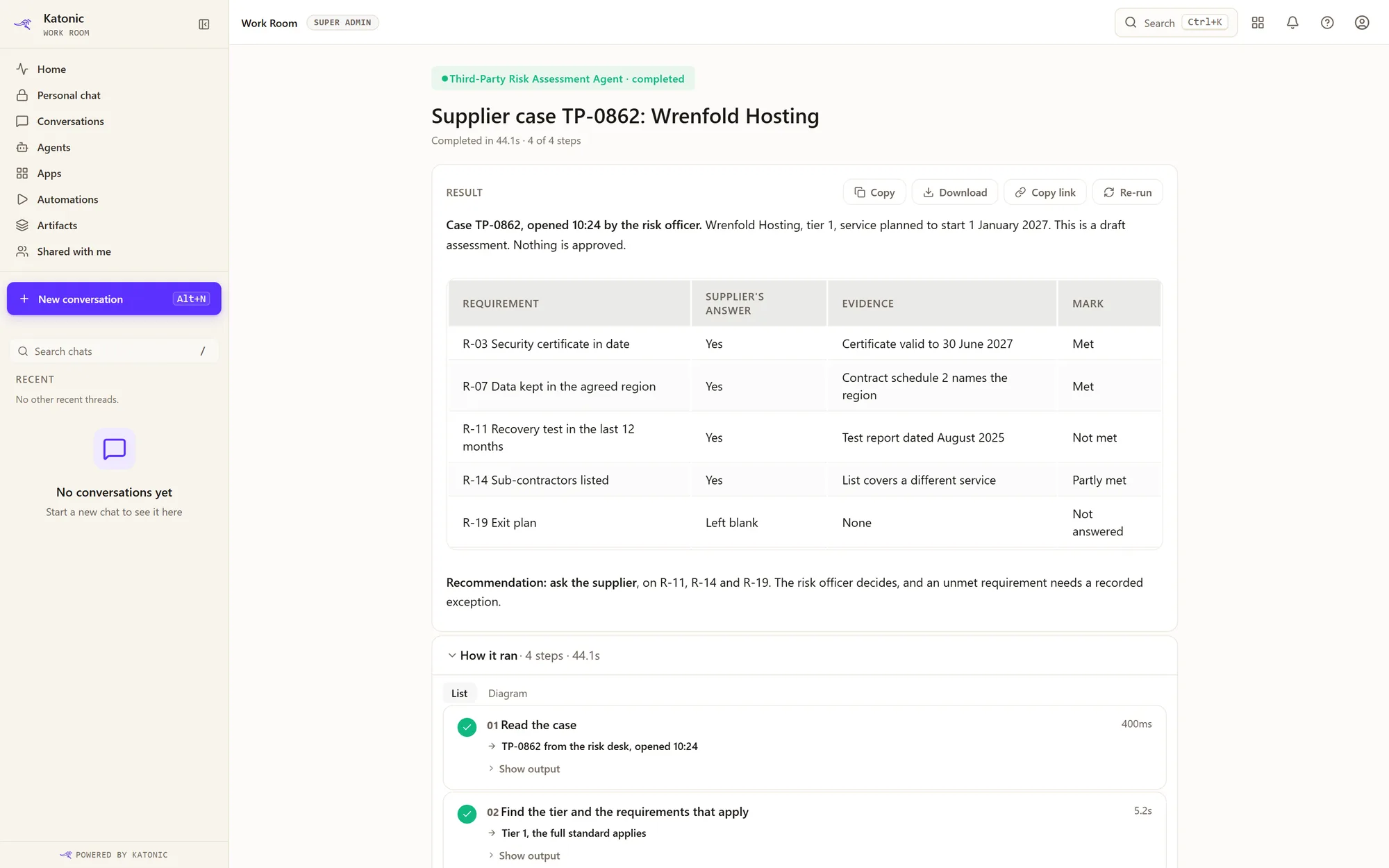
Tap the screen to open it at full size.
Reads from · connectors
What the case hands over: the supplier's questionnaire, its evidence and the passages of your standard. Nothing else.
What it can change
Nothing. It has no tool and writes to no system.
Nobody has to ask.
It starts when something arrives.
Katonic calls this an event-triggered agent, one kind of workflow agent: it starts when something happens in a system, such as an email arriving, a file landing or a record changing.
What is an event-triggered agent? →The four types of agent →
01 · How it starts
When something arrives
Another system tells it that something has happened, and it starts by itself. Nobody has to watch a queue.
02 · Where your people see it
In Work Room, under Automations
Each run appears in Work Room under Automations. A run that needs a decision waits there for a person.
See Work Room →03 · Where they already work
In a screen they already use
Your developers can put it behind a screen your people already work in, so nobody has to open a new tool.
For your IT team. Another system can start a run through the REST API or a webhook. An action that is held for approval still waits for a person, however the run was started.Public API →
What you set up
- Write your supplier standard as numbered requirements, with the tiers they apply to.
- Send each case with the questionnaire, the evidence and the planned start of the service.
- Test it on suppliers you have already assessed.
Where it runs
The agent, its knowledge store and the model run on infrastructure you own or control. You choose the model and serve it yourself, so questions, documents and answers are not sent to a public AI service. Suppliers' security answers and evidence stay inside the bank.
How you get it today
You build it in Katonic Studio: describe the job, connect what is named above, add test cases and release the agent once it passes them. There is no ready-made template for this job yet.
Does it approve a supplier?
No. It recommends. The risk officer decides, and the committee your standard names approves the most critical suppliers.
What if the supplier left an answer blank?
The answer stays blank and is marked not answered. The agent does not fill it in from what suppliers usually do.
Does it check dates?
Yes. Where a requirement must be in place before the service starts, it compares the date on the evidence with the planned start.